


Conference Program
- oliwabattle400
- 3 lip
- 4 minut(y) czytania

Conference Program
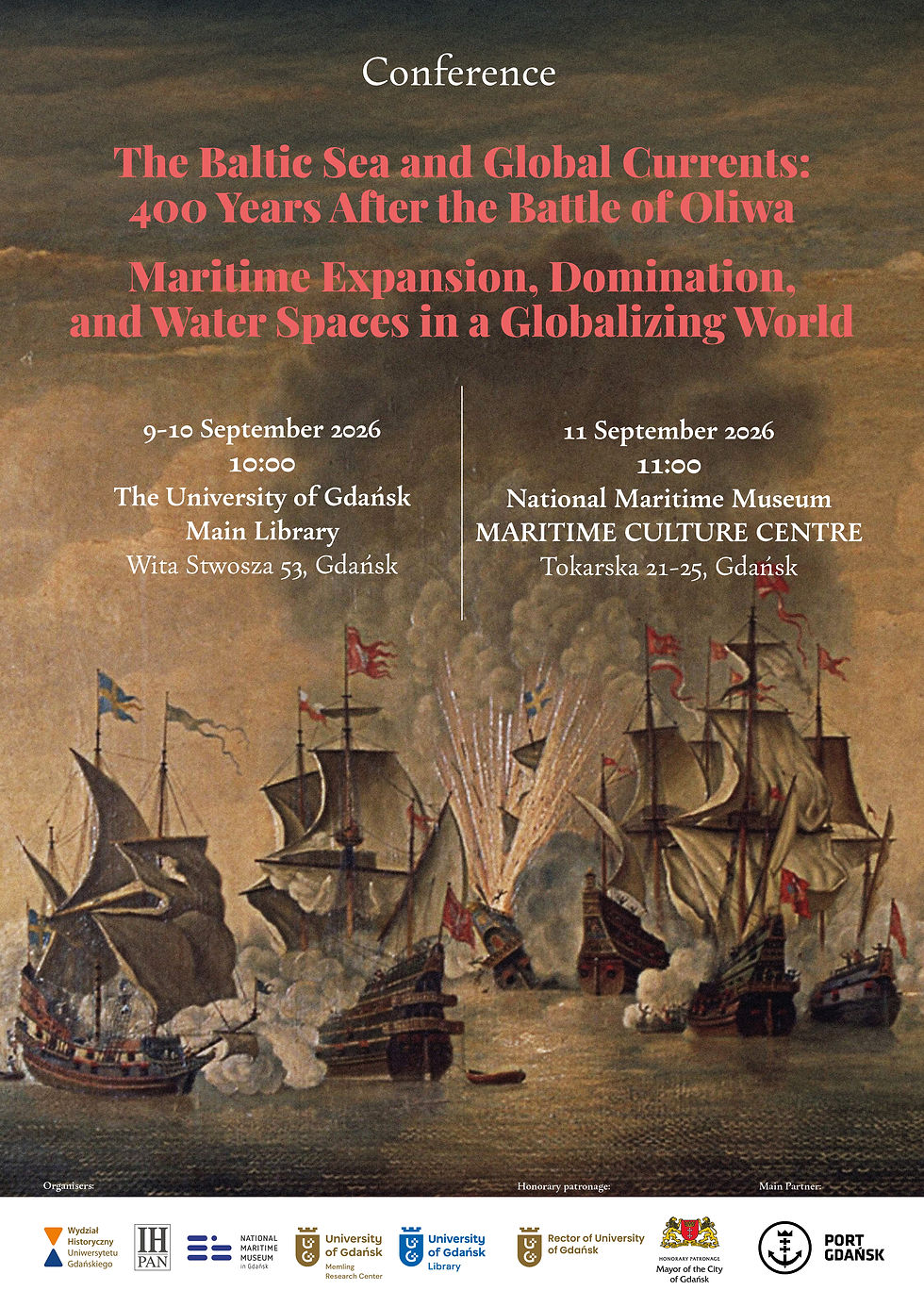
The Baltic Sea and Global Currents: 400 Years After the Battle of Oliwa
Maritime Expansion, Domination, and Water Spaces in a Globalizing World

9.09.2026 (Wednesday)
Venue: University of Gdańsk (Uniwersytet Gdański), Campus, UG Library, Wita Stowsza 53, Gdańsk, Poland
Registration: 9.00-10.00
Opening of the conference 10.00-10.30
10.30-11.40 - Key lecture
Johan Rönnby (Professor Archaeology. Head MARIS, Maritime Archaeological Research Institute at Södertörn University): The Princes' Ships: Maritime Archaeological Perspectives on Power and Social Change in the Early Modern Period.
Coffee break 11.40-12.00
Session 1: 12.00-14.00
Panel: Gdańsk and the Baltic in the Early Seventeenth Century
Sławomir Kościelak (University of Gdańsk): An alleged attempt to initiate secret negotiations between Gdańsk and Sweden on the eve of the invasion in July 1626
Iwona Janicka ( Uniwersytet Gdański): The micro-emotions of high politics: how the people of Gdańsk reacted to the visits of Sigismund III Vasa?
Krzysztof Kurzyk (National Maritime Museum in Gdańsk): The Art of Navigation in the Baltic Sea at the time of the Battle of Oliwa. Navigational instrumentsfrom the Solen wreck.
Paweł Litwinienko (National Maritime Museum in Gdańsk): Rigging and sailing the 17th century warship as evidenced in historical and archaeological sources on Solen
Lunch: 14.00-15.30
Session 2:(part 1): 15.30-17.00
Panel: The Human Experience of Naval Warfare in the Seventeenth-Century Baltic
Ewa Bojaruniec-Król (Medical University of Gdańsk, Museum of Gdańsk) and Andrzej Szarzewski (Medical University of Gdańsk): Arend Dickmann (1572–1627) – A Man of the Sea in the Service of the Maritime Community
Fred Hocker (Vasa Museum) and Tomasza Bednarz (University of Gdańsk, National Maritime Museum in Gdańsk): Artillery of the Swedish warship Solen, sunk 1627
Jerzy Jankau (Medical University of Gdańsk): Arndt Dickmann’s Death by Gunshot: A Contemporary Surgeon’s Perspective
Coffee break: 17.00-17.15
Session 2: (part 2): 17.15-18.15
Anna Rembisz-Lubiejewska (National Maritime Museum in Gdańsk): Medical assistance on 17th warship in the light of the barber’s equipment discovered on the Solen wreck
Dariusz Kaczor (University of Gdańsk): ‘ein kießenbüehren, darinnen ist ein hembde’. Living conditions on ships in the light of Danzig inventories of seafarers' property from the 16th and 17th centuries
Welcome reception: 18.30-20.00
THURSDAY, 10.09.2026
Venue: University of Gdańsk (Uniwersytet Gdański), Campus,
UG Library, Wita Stwosza 53, Gdańsk, Poland
Session 3: 10.00-12.00
Panel: Between the Atlantic and the Baltic: Ships and Naval Warfare in the Early Modern Period
A. Jorge Aguilera-López (University of Helsinki): Between Two Seas: The Atlanticisation of the Spanish Galley, 1580–1600
Michał Grabowski (University of Warsaw): In the Shadow of Great Sails - Local Shipbuilding Traditions in the Bay of Gdańsk Region, 16th–18th Centuries
Krzysztof Kuczyński (University of Warsaw): The Story of the Frigate “Postillion”: Tracing the Last Polish Privateer to Fight the Swedes
Arkadiusz Janicki (University of Gdansk): The story of a single smack-ship. The activities of the insurgents in the vicinity of Palanga in 1794
Coffee break: 12.00-12.15
Session 4: 12.15-14.15
Panel: People, Work, and Welfare in Early Modern Maritime Worlds
Matilda Jarl (Södertörn University): Feeding sailors and soldiers. Foodways on early modern naval ships in the Baltic Sea area
Patrik Höglund (Swedish National Maritime And Transport Museums): Transport and Military Museums, The Ship Society. Rank, Roles and Status on Swedish Warships in the 17th century
Eduardo Sartoretto (Anthropos Doctoral School, Institute of History of Polish Academy of Sciences): The petitioners fear that, once the unloading is complete, they too will be unable to find work: an analysis of the social, legal, and labor
dynamics of Portuguese seafarers in the second half of the 18th century
Radosław Kubus (University of Gdańsk): Maritime Accidents in the Baltic Sea and the Emergence of Organised Rescue Services in Gdańsk in the Late Enlightenment (up to the early nineteenth century)
Lunch: 14.15-15.45
Session 5 (part 1): 15.15-16.45
Panel: Threats from the Sea: Defensive Responses and Institutional Disputes. The Fortification of the Archipelagos of the Hispanic Monarchy in the Long 18th Century
Sergio Solbes Ferri (University of Las Palmas de Gran Canaria): Proposals for Improving the Financing of the Canary Islands’ Defences in the Second Half of 18th Century: The General Board of Fortifications
Johanna von Grafenstein (Mora Institute): The Gulf of Mexico and Caribbean Sea: The Role of Fortifications in Defence of Spanish Ports and Navigation Routes,18th Century.
Rafał Reichert (University of Warsaw): The Price of Security: The Military Financing Challenges of Santo Domingo and San Juan Garrisons in the 17th Century
Coffee break: 16.45-17.00
Session 5 (part 2): 17.00-18.00
Ana María Coll Coll (Universitat de les Illes Balears), Defence and resource management in the Mediterranean: the challenge of 18th Century Mallorca
Jaime Acosta Pozuelo (University of Las Palmas de Gran Canaria/University of Bayreuth): The Rearguard of the Empire: The Financing of Military Expenditure and Fortifications in the Spanish Philippines during the 18th Century.
Dinner: 18.30
FRIDAY, 11.09.2026
9.00-10.30: Special Museum Tour: National Maritime Museum- Branch at Ołowianka, Ołowianka 9, Gdańsk
Conference Venue: National Maritime Museum- MARITIME CULTURE CENTRE, Tokarska 21-25, Gdańsk
Session 6: 11.00-13.00
Panel: Maritime Imaginaries, Coastal Defences, and Changing Seascapes
Monika Jankiewicz-Brzostowska (National Maritime Museum in Gdańsk): The Political Connotations of Ship Images in Dutch 17th Century Art
Maciej Flis (Museum of Gdańsk): Wisłoujście Fortress as a Naval Port of the Fleet of Sigismund III Vasa, 1626–1628
Piotr Samól (Gdańsk University of Technology): Coastal castles on the Baltic Sea during the Thirty Years' War – preliminary research
Fanni Kovács (Eötvös Loránd University): Whales and an Altering Seascape: Managing Environmental Changes in the Seventeenth- Eighteenth-Century Whaling Industry around Svalbard
Lunch: 13.00-14.30
Session 7 (part 1): 14.30-16.00
Panel: People and Power in Early Modern Maritime Networks
Bogdan Burliga (University of Gdańsk) Remembering Seaman Peter Simsen: Oliwa, 28 November 1627, and the Polish Legacy of the Idea of dominium Maris Baltici
Marcin Swobodziński (University of Gdańsk): Military Operations in Royal Prussia in 1627, as Described in the Accounts of the Brandenburg Envoys in Poland (paper in German)
John Freeman: Warship Diplomacy: The Promise of Warships in the Duchy of Courland’s Attempts to Gain English Favour in the Seventeenth Century
Coffee break: 16.00-16.15
Session 7 (part 2): 16.15- 17.15
Aleksandra Jasniewicz-Downes: Personnel from Gdansk in the service of the Dutch East India Company.
Edna Matos (Federal University of Sergipe): A Zealous Imperial Commander: Order, Control, And Reformism in The Correspondence Of Donald Campbell (1799-1801)
Summary and closing remarks

Komentarze